Table of Contents
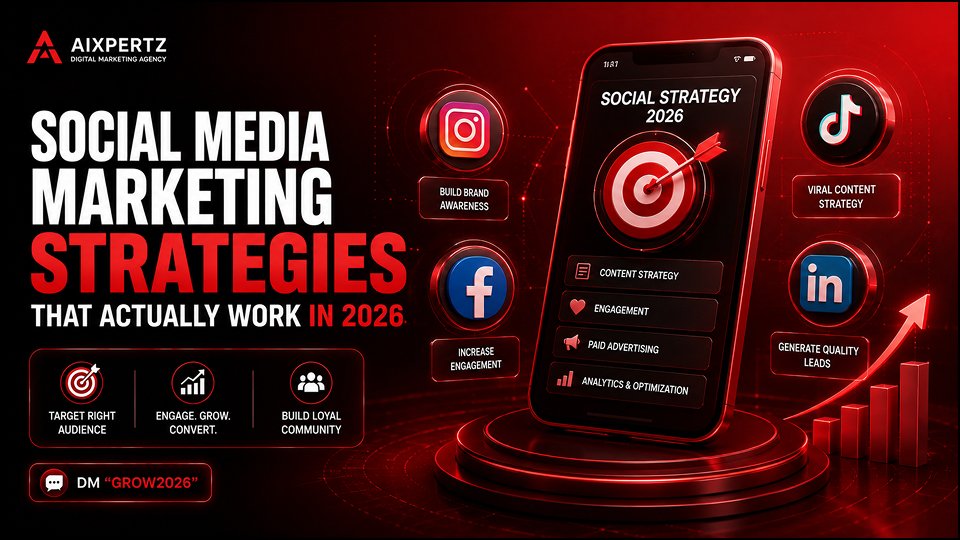
ToggleSocial Media Marketing Strategies That Actually Work in 2026
Picture this: You’re posting consistently on Instagram, Facebook, and LinkedIn. You’re using hashtags. You’re sharing behind-the-scenes content. But your engagement is flat. Your follower count isn’t moving. And your phone isn’t ringing.
Sound familiar?
A few years ago, you could post consistently on Instagram or Facebook and expect steady organic growth. Those days are largely gone . Algorithms have tightened, competition has intensified, and the average social media user is more selective than ever about what they engage with .
I recently spoke with a small business owner in Chennai who was frustrated. “Arjun, I’m posting every day. I’m doing everything the gurus say. Why isn’t it working?”
She had a social media marketing strategy problem. She was treating 2026 like it was 2020.
Here’s the truth: the old playbook—post often, use hashtags, hope for the best—is no longer enough . But the businesses that adapt to how social media actually works in 2026 have more tools and channels available than ever before .
What Is a Social Media Marketing Strategy in 2026?
A social media marketing strategy is a structured, goal-driven plan that defines how a brand uses content, platforms, data, and tools to reach the right audience, drive engagement, and achieve measurable business outcomes .
Without a clear strategy, you’re producing content that serves no one . Every post, reply, and campaign should connect back to a specific business objective—whether that’s brand awareness, lead generation, or direct revenue .
The biggest shift in 2026? Your strategy must define how AI fits into your execution . What tasks does AI handle? Where does a human stay in the loop? How do you train AI agents to sound like your brand? .
Step 1: Pick Two Platforms and Go Deep
The biggest mistake growing businesses make is trying to maintain a presence everywhere at once. A stretched-thin presence on six platforms will always underperform a focused, consistent presence on two .
Here’s how to choose:
| Target Audience | Primary Platform | Secondary Platform |
|---|---|---|
| B2B professionals | YouTube | |
| Gen Z consumers | TikTok | |
| Millennials | ||
| Gen X & Boomers | YouTube | |
| Local businesses |
The right two depend on your audience . Commit to your chosen platforms, understand how their algorithms reward content, and resist the pressure to be everywhere simultaneously .
Important: While many brands pour effort into TikTok and Instagram, consumers across generations actually plan to spend the most time on Facebook, followed by Instagram and YouTube . Winning strategies align with actual audience habits rather than industry assumptions.
Step 2: Set SMART Goals (Not Vanity Wishes)
Your goals should follow the SMART framework: Specific, Measurable, Achievable, Relevant, and Time-bound .
For example, “get more followers” isn’t a goal. But “increase Instagram engagement rate by 15% in Q1 by shifting to Reel-first content” is .
Match each goal to a KPI that proves impact :
| Objective | KPI |
|---|---|
| Awareness | Reach, impressions, profile visits |
| Lead generation | Link clicks, landing page visits, form fills |
| Purchases | Conversion volume, revenue from social traffic |
| Repeat business | Repeat purchase rate, returning visitor activity |
| Customer care | First-response time, resolution time |
Keep the goal count tight. Small teams make better decisions when every post, reply, and campaign answers the same commercial need instead of chasing five different wins at once .
Step 3: Define Your Content Pillars
Consistency is the single most important factor in long-term social media growth, and the biggest barrier to consistency is running out of ideas . Content pillars solve this by giving you a defined set of themes to rotate through .
Five content pillars that work:
Educational content – Teach your audience something valuable
Behind-the-scenes – Show the people and process behind your brand
Customer stories – Real people, real results
Product content – Demonstrations, features, and benefits
Opinion posts – Share your unique perspective
With five pillars and a posting cadence of five times per week, you never start from a blank page . Build a simple content calendar and batch-create where possible .
Step 4: Short-Form Video Is Non-Negotiable
TikTok, Instagram Reels, and YouTube Shorts are the highest-reach formats available to businesses right now, and they remain largely meritocratic—a small account with a great video can still reach tens of thousands of people without spending a penny .
The key is creating content that earns attention in the first two seconds. Hook first, context second, and call to action last .
Platform-specific posting frequency :
| Platform | Recommended Frequency |
|---|---|
| TikTok | 1–3x daily |
| 1–2x daily (feed) + Stories | |
| 2–5x weekly | |
| 1–2x daily |
Step 5: Creative Has Officially Replaced Targeting
Here’s the biggest shift in 2026: your creative is your targeting .
AI-led systems like Meta’s Advantage+ now analyze creative assets directly. These models interpret visual cues, audio, captions, and contextual signals to determine who should see the ad . In practice, the creative now dictates the audience .
What this means for your social media marketing strategy:
If the goal is to reach pet owners, selecting interest-based targeting matters far less than showing a dog, demonstrating pet behavior, or addressing a pet-specific problem within the content itself .
Success depends less on audience groups and exclusions and more on producing content that clearly communicates intent to both the algorithm and the user .
Creatives that work in 2026:
Lo-fi wins over polished – Highly produced ads increasingly struggle to hold attention. User-generated and creator-led assets consistently outperform traditional brand creatives, with engagement rates reported to be 8.7x higher in certain verticals .
Founder-led content – The accounts that grow fastest feel like people, not corporations. Reply to comments genuinely. Show behind-the-scenes content. Be occasionally imperfect .
Step 6: Engage Like a Human, Not a Brand
The accounts that grow fastest on social media in 2026 are the ones that feel like people, not corporations . This means replying to comments genuinely, jumping into relevant conversations in your niche, showing behind-the-scenes content, and occasionally being imperfect .
Social customer care best practices :
73% of social media users expect brands to respond within 24 hours
70% expect personalized responses
52% of customers who receive real-time responses report higher brand loyalty
A note on AI and authenticity: While many marketing leaders prioritize AI-generated content, consumers have ranked human-generated content as their #1 priority for 2026 . Small businesses that lead with authenticity will satisfy the growing appetite for “real” brand experiences that AI can’t yet replicate .
Step 7: Track Metrics That Actually Matter
Vanity metrics—impressions, follower counts, likes—feel good but rarely tell you whether social media is contributing to your business .
The metrics that matter :
Link clicks
Profile visits
Direct messages
Leads or sales that can be attributed to social activity
Set up UTM tracking on every link you share, check your analytics weekly, and be willing to kill content formats that don’t move the right numbers even if they get plenty of likes .
Step 8: Turn Your Best Content Into Paid Ads
Organic social and paid social should not be separate strategies . Your best-performing organic posts—the ones that generated real engagement without promotion—are telling you exactly what your audience responds to .
Those are the posts worth putting your budget behind. Boosting proven organic content as paid ads is consistently more effective than creating content specifically for ads, because the social proof is already there and the creative has already been validated by real people .
Step 9: Optimize for Social Search
Social platforms are increasingly driven by interest and intent. For younger generations, particularly Gen Z, platforms like TikTok and Instagram are now the primary search engines .
Optimize for social search :
Incorporate keyword-rich captions
Add on-screen text that clearly articulates the user problem your content solves
Use relevant hashtags strategically
Create content that directly addresses specific queries
A video that directly addresses “best budget skincare for winter” is more likely to rank in search results than a generic brand video .
Conclusion: Stop Wasting Time on Social Media
Social media is not a side project you squeeze between invoices and inventory counts. It’s a direct line to your audience, your reputation, and your next customer .
Here’s your social media marketing strategy checklist:
Audit your current accounts (what’s working, what’s not)
Pick 2 platforms and commit to them
Set SMART goals with clear KPIs
Define 3-5 content pillars
Create platform-native short-form video
Test creative formats (lo-fi, founder-led, UGC)
Engage like a human, not a brand
Track metrics that actually matter
Boost proven organic content as ads
Optimize captions for social search
Review performance monthly, pivot quarterly
The brands that win on social media don’t post the most. They operate with focus, respond with empathy, and back every decision with data .
Ready to master social media marketing and other digital marketing skills?
Our Digital Marketing Course in Chennai covers social media strategy, SEO, Google Ads, content marketing, and all the 2026 strategies you need to drive real business results. With live projects, agency-style training, and placement support, you’ll graduate ready to build a social media strategy that actually works.
Take the Next Step:
📞 Call: +91 6379618098
📧 Email: aixpertz38@gmail.com