Table of Contents
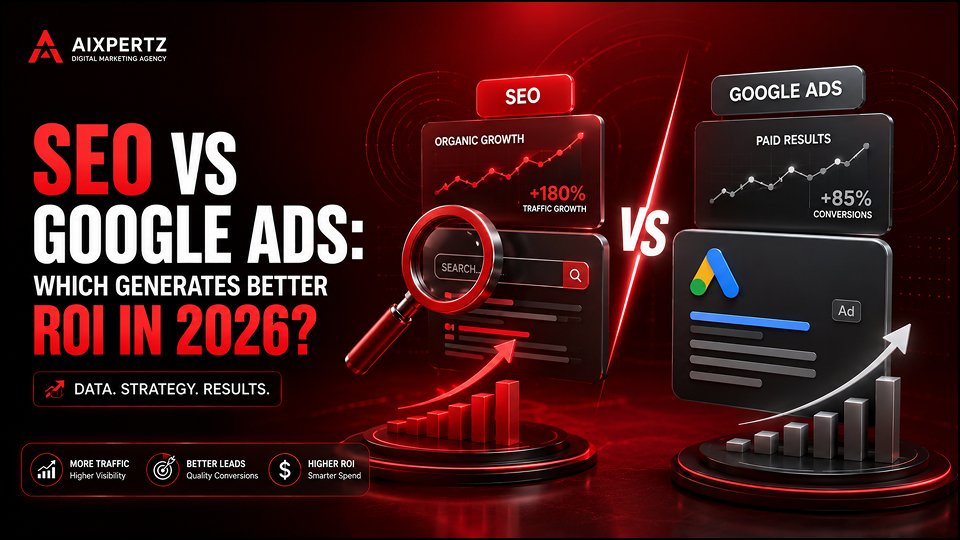
ToggleSEO vs Google Ads: Which Generates Better ROI in 2026?
Picture this: You’re a small business owner with a ₹50,000 marketing budget burning a hole in your pocket. You’ve heard SEO can bring free traffic for years, but you need customers now. Meanwhile, your competitor is everywhere on Google with those fancy “Sponsored” tags.
You’re stuck.
I recently sat down with a friend running a boutique digital agency in Chennai. He said, “Arjun, I’ve got clients asking me every single day—should I put my money on SEO or just run Google Ads? Everyone wants a straight answer, but honestly, it depends on where they are.”
He’s right.
If you’re searching for a Digital Marketing Course in Chennai that actually teaches you how to make these decisions, you’re in the right place. But first, let’s settle this debate once and for all.
The Big Question: SEO vs Google Ads
The SEO vs Google Ads debate isn’t new. But in 2026, the stakes are higher. Google’s AI Overviews are appearing in 25–48% of searches now . Paid ad costs are rising across 87% of industries . And organic search still drives roughly 68% of all website traffic in markets like Australia .
So which one actually gives you better returns?
The honest answer: It depends on your timeline, budget, and goals.
But here’s the thing—SEO delivers 748% average ROI compared to Google Ads’ 200% average ROI . That’s 3.7x more bang for your buck.
Yet businesses still spend billions on Google Ads. Why? Because it works immediately.
Let me break this down in plain language.
What Each Channel Actually Does
SEO: The Long-Term Asset
SEO (Search Engine Optimization) is about earning your spot in Google’s search results without paying for every single click .
Think of it like buying a house instead of renting. You put in the work upfront—improving your website, creating useful content, and building authority—and over time, that investment starts paying dividends. A well-optimized blog post you publish today can bring you customers 3, 6, or even 36 months later at zero additional cost .
How SEO builds value:
Content quality and relevance matter more than ever
Technical health (speed, mobile-friendliness, crawlability)
Backlinks from trusted sites build authority
E-E-A-T signals (Experience, Expertise, Authoritativeness, Trustworthiness)
Here’s the catch: SEO takes time. We’re talking 3 to 6 months for initial traction, and 6 to 12 months to see meaningful ROI in competitive industries .
Google Ads: The Immediate Growth Lever
Google Ads are paid placements at the top of Google’s results .
Think of this as renting a billboard on the busiest road in town. As soon as you pay, your business is visible. But the moment you stop paying, your ad vanishes .
How Google Ads works:
You bid on keywords (like “best digital marketing course Chennai”)
You pay only when someone clicks (hence, Pay-Per-Click or PPC)
Campaigns can go live within hours, not months
You have total control over budget, targeting, and messaging
The catch: In competitive industries like legal services, clicks can cost $10–$50 or more . And the moment you pause spending, your traffic drops to zero. No residual value. No compounding.
SEO vs Google Ads: Head-to-Head Comparison
Let’s put these two side by side. This is what you actually need to know.
| Dimension | Google Ads | SEO |
|---|---|---|
| Speed to Results | Immediate (same day) | 3–6 months for traction |
| Cost Structure | Pay per click, ongoing | Investment-based, compounding |
| Average ROI | ~200% | ~748% |
| Trust Factor | “Sponsored” label = lower trust | Perceived as earned = higher trust |
| Compounding Value | None – stops when you stop paying | Yes – rankings persist and grow |
| Best For | Quick wins, product launches, seasonal peaks | Long-term growth, authority-building |
| Traffic After Pausing | Stops immediately | Continues for months or years |
What the data actually says:
Organic search drives more website traffic than paid search for most industries
70–80% of users skip paid ads and click organic results
Organic conversion rates average 14.6% vs Google Ads at 3.75%
Position 1 organic CTR is ~28.5%, while top ad CTR is just 3.2%
Cost Comparison: The ₹5 Lakh Scenario
Let me make this real.
Imagine you’re running a digital marketing agency in Chennai and you have ₹5,00,000 to invest over 12 months.
Option A: All in on Google Ads
Average CPC for B2B/SaaS terms: ₹1,000–₹1,200
Monthly clicks: ~417
Conversion rate: ~3%
Monthly leads: ~12–13
Total leads in 12 months: ~150
Problem: Leads stop completely when budget runs out
Option B: All in on SEO
Months 1–3: Building strategy, fixing technical issues, publishing content
Months 4–6: Ranking for long-tail keywords, 200–400 monthly visits
Months 7–8: Break-even point
Months 9–12: Traffic compounds to 1,200–1,800 monthly visits
Total leads in 12 months: ~130–160 (comparable to paid by end of year)
Key difference: The SEO machine keeps running after month 12
According to industry data, the SEO vs Google Ads crossover point for most B2B companies is around month 7–8 . Before that, paid search delivers more leads per rupee. After that, organic SEO crushes it on economics.
When to Choose Google Ads
Google Ads wins when you:
Need leads immediately – New business launch, seasonal spike, emergency service
Want to validate demand quickly – Test new keywords or offers before investing in SEO
Have time-sensitive promotions – Clearance sales, limited-time offers, events
Face hyper-competitive SEO landscapes – If competitors have years of SEO advantage
Real-world example: A plumber running “emergency plumber near me” ads. At midnight, when a pipe bursts, someone clicks the ad and calls. One job pays for the entire ad spend .
When to Choose SEO
SEO is better when you:
Can afford to wait 3–6+ months for meaningful results
Want sustainable, long-term growth without being tied to constant ad spend
Are building authority and trust in your industry
Face high CPC costs in your industry (like legal, insurance, or finance)
Real-world example: A cybersecurity client facing CPCs over $70 for paid clicks. With long buying cycles, ads just didn’t convert. SEO captured demand across the entire customer journey and delivered better lead quality at a fraction of the cost .
The Smart Money Strategy: Use Both
Here’s what most articles won’t tell you: Companies using both SEO and Google Ads together see roughly 35–40% higher ROI than those using only one .
The best approach? A phased strategy :
Phase 1 (Months 1–3): Lead with Google Ads. Get immediate leads while building your SEO foundation.
Phase 2 (Months 4–8): Publish SEO content targeting keywords that convert best in your ads. Reduce ad spend on keywords you’re ranking for organically.
Phase 3 (Months 9–12+): SEO takes over. Ads become surgical – used only for brand defense, remarketing, and testing new markets.
The Skills You Need to Win in 2026
Here’s the hard truth: Neither SEO nor Google Ads works if you don’t know what you’re doing.
Businesses waste money every day because they:
Send ad traffic to their homepage instead of targeted landing pages
Create SEO content without understanding search intent
Don’t track conversions properly
Expect SEO to work overnight
That’s why the Digital Marketing Course in Chennai at Aixpertz teaches you both sides of the equation. You learn:
SEO – On-page, off-page, technical, and local SEO
Google Ads – Search, display, shopping, and Performance Max campaigns
Data analysis – How to read campaign data and make smart budget decisions
Strategy – When to use SEO vs Google Ads vs both
Whether you want a Digital Marketing Course with Placement, a 100% Job Guarantee Digital Marketing Course, or just the best Digital Marketing Training in Chennai, learning both channels is non-negotiable in 2026.
Conclusion
So, SEO vs Google Ads – which wins?
If you need results now: Google Ads.
If you’re playing the long game: SEO.
If you’re smart: Use both.
The numbers don’t lie. SEO gives you 748% ROI, but it takes time. Google Ads gives you 200% ROI, but it starts working today .
The businesses that win in 2026 don’t choose one or the other. They use Google Ads as a fast-learning tool – testing keywords and offers – and then build SEO content around what works. Over time, organic rankings reduce their reliance on paid clicks. And when ad costs inevitably rise, they have a durable asset that keeps bringing in customers.
Ready to master both channels?
Our Digital Marketing Course in Chennai covers SEO, Google Ads, social media, content marketing, and the latest 2026 strategies. With live projects, agency-style training, and placement support, you’ll graduate ready to make smart marketing decisions – not just guess.
Take the Next Step:
📞 Call: +91 6379618098
📧 Email: aixpertz38@gmail.com