Table of Contents
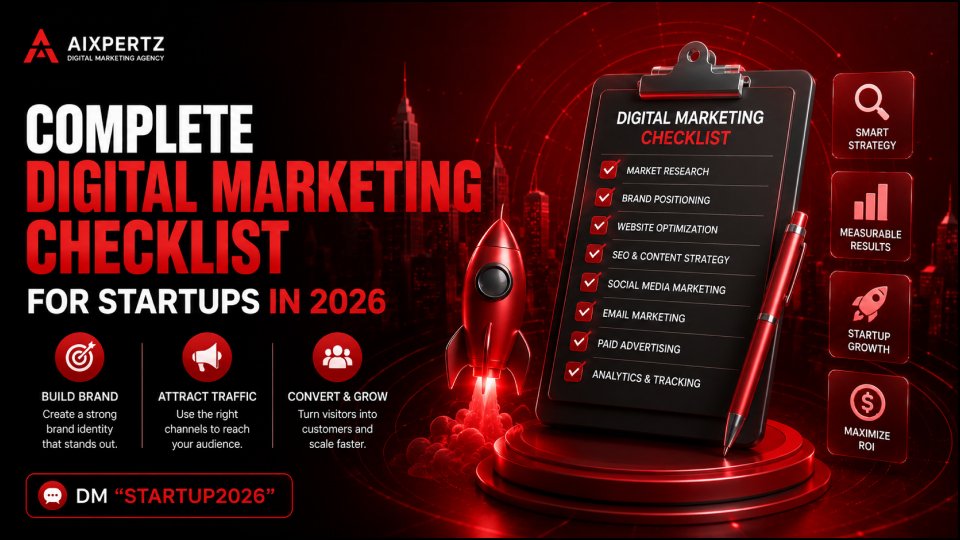
ToggleComplete Digital Marketing Checklist for Startups in 2026
Picture this: You’ve just launched your startup. You have a great product. You’re excited. You start posting on Instagram, running a few Google Ads, and sharing content on LinkedIn.
Three months later, your budget is drained. Your phone isn’t ringing. And you’re wondering what went wrong.
I’ve seen this happen more times than I can count. And the problem isn’t the product—it’s the lack of a structured approach. Digital marketing for startups in 2026 isn’t about doing everything. It’s about doing the right things in the right order.
A startup that lacks a clear digital marketing strategy is like a ship without a compass. Digital marketing without a plan can drain your budget fast. But with the right checklist, you can turn limited resources into measurable growth.
Let’s fix that. Here’s your complete digital marketing for startups checklist for 2026.
Step 1: Build Your Brand Foundation First
Before you run a single ad or post on social media, get your basics right.
Your foundation checklist:
Define your brand voice, colors, and logo
Know exactly who your target customer is (create detailed buyer personas)
Set clear and measurable marketing goals (use the SMART framework)
Study your top competitors online
Create uniformity in brand image and communication
A strong foundation saves you from expensive mistakes later. Startups with a clear digital marketing plan are far more likely to attract and retain customers, generate leads, and build a brand presence that lasts.
Step 2: Set Up a Professional Website
Your website is the most important digital asset for your startup. It’s the central hub where all your marketing efforts should lead.
Website checklist:
Choose a clean, mobile-friendly design that loads in under 3 seconds
Add essential pages: Home, About, Services/Products, Blog, and Contact
Install Google Analytics and Google Search Console from day one
Ensure your site is fast—aim for LCP under 1.8 seconds
Research shows that as page load time increases from 1 second to 3 seconds, the probability of a bounce increases by over 30%. A fast site doesn’t just rank better—it converts better.
Step 3: Build Your SEO Foundation
Search engine optimization is the backbone of digital marketing for startups. It helps customers find you without paying for every single click.
SEO checklist:
Technical Foundation
Core Web Vitals: LCP under 1.8 seconds, INP under 200ms, CLS under 0.1
Schema Markup: Add Organization, Founder, Product, and FAQ schema
Website Structure: Ensure your site is crawlable and logically organized
On-Page SEO
Research keywords your customers are actually searching
Optimize every page title, heading, and meta description
Start with bottom-of-funnel and problem-aware searches first
Use structured headings and descriptive alt text for images
Off-Page SEO
Build backlinks through guest posts and directory listings
Submit to high-authority startup directories and announcement platforms
Focus on quality over quantity—20 relevant sites beat 200 spammy ones
Local SEO
Create a Google Business Profile and keep it updated
Focus on local SEO if you serve a specific region
Pages with FAQPage schema are 3.2 times more likely to appear in Google AI Overviews. This is a free, high-impact component that older guides overlook.
Step 4: Choose the Right Social Media Platforms
You don’t need to be everywhere. You need to be where your audience is.
Platform selection guide:
| Business Type | Primary Platforms | Supporting Platforms |
|---|---|---|
| D2C / E-commerce | Instagram, TikTok | Facebook, YouTube |
| B2B / SaaS | LinkedIn, X (Twitter) | YouTube, Webinars |
| Local Services | Facebook, Instagram | Google Business Profile |
| EdTech / Coaching | YouTube, Instagram | LinkedIn, WhatsApp |
Social media checklist:
Set up complete profiles with consistent branding
Plan your content at least two weeks ahead
Consistency matters more than posting frequency
Startups with an active social media presence grow up to 10× faster.
Step 5: Create Content That Solves Real Problems
Content marketing builds trust before the sale happens. It also generates three times more leads than outbound marketing at 62% less cost.
Content checklist:
Start a blog targeting your primary keywords
Publish how-to guides, tips, and industry insights
Use the Topic Cluster Model—pick one narrow problem and write 15 articles covering every angle
Use video content to boost engagement
Repurpose one blog post into multiple formats (reels, infographics, emails)
Business blogging can drive 55% more website visitors. Great content brings organic traffic for months and years.
Step 6: Build Your Email List Early
Your email list is an audience you own completely. It delivers one of the highest returns of any digital channel.
Email marketing checklist:
Offer a free resource (lead magnet) to collect email sign-ups
Write a welcome email series to introduce your brand
Send weekly or bi-weekly emails with value-first content
Track open rates, click rates, and conversions
Segment your list based on behavior and interests
Step 7: Run Paid Ads With a Clear Strategy
Paid advertising speeds up growth when done correctly. But don’t rely on paid media alone—use it to accelerate organic efforts.
Paid ads checklist:
Start with a small test budget before scaling
Google Ads work well for high-intent searches
Meta Ads are great for awareness and retargeting
Always set up conversion tracking before your first campaign
Test multiple ad creatives and optimize weekly
Businesses using both SEO and paid ads together see roughly 35-40% higher ROI than those using only one. This is especially true for digital marketing for startups.
Step 8: Leverage Generative Engine Optimization (GEO)
Google’s AI Overviews now summarize the web for users. To be the source for that AI, optimize for it.
GEO checklist:
Start every article with a 40-60 word summary of the answer
Use specific numbers and cite original sources
Include real screenshots, first-person statements, and unique case studies
FAQ schema helps—it’s 3.2× more likely to appear in AI Overviews
In an era where AI Overviews prioritize the most reliable data sources, structured data ensures your brand’s information appears accurately.
Step 9: Measure What Actually Matters
Data tells you what’s working and what’s wasting your budget.
Metrics that matter:
| Objective | Metrics to Track |
|---|---|
| Awareness | Reach, impressions, AI Overview visibility |
| Lead Generation | CPL (cost per lead), qualified lead volume |
| Sales | CAC (customer acquisition cost), ROAS, conversion rate |
| Retention | LTV, repeat purchase rate, churn rate |
Marketing without tracking is just guessing. Review your analytics monthly and be ready to pivot quickly.
The Right Order Matters
Here’s the dirty secret about digital marketing for startups: most ventures fail not because they choose the wrong tools, but because they implement them in the wrong sequence.
The 5-layer progression:
Conversion-ready website – Your foundation
Google Business Profile optimization – For local visibility
Sustainable content engine – Blogging, SEO, and resources
Email infrastructure – Your owned audience
Multi-channel distribution – Paid ads, social, and PR
Skip a layer, and your efforts won’t compound. Build in the right order, and every activity amplifies the one before it.
Real-World Proof
Wyrdryds (Electric Vehicles): With a targeted SEO and content strategy, they saw a 3× increase in monthly organic sessions and got 15 keywords ranking in Google’s top 10.
Shoebacca (Footwear Retailer): Social media marketing grew their Instagram followers from 1K to 15K in just 2 months, with 1,400+ purchases directly attributed to social campaigns.
Knowlesys (Cybersecurity B2B): A focused PPC campaign generated 220 qualified B2B leads in 2 months while reducing CPC by 28%.
These aren’t massive enterprises. They’re startups that executed the right strategies in the right order.
Conclusion
Digital marketing for startups in 2026 isn’t about massive budgets. It’s about a smart, consistent strategy that builds in the right sequence.
Your complete checklist:
Brand foundation defined (voice, audience, goals)
Professional website (fast, mobile-friendly, tracked)
SEO foundation (technical, on-page, off-page)
Google Business Profile claimed and optimized
Social media presence on 1-2 key platforms
Content engine (blog, videos, lead magnets)
Email list built and segmented
Paid ads running with conversion tracking
GEO optimization (schema, direct answers)
Analytics tracking metrics that matter
Monthly reviews and pivots as needed
Take action today. Your competitors already have.
Ready to master digital marketing and build your startup’s growth engine?
Our Digital Marketing Course in Chennai covers SEO, social media, Google Ads, content marketing, AI tools, and all the 2026 strategies you need to scale a business. With live projects, agency-style training, and placement support, you’ll graduate ready to drive real results—not just theory.
Take the Next Step:
📞 Call: +91 6379618098
📧 Email: aixpertz38@gmail.com